September saw the UK manufacturing upturn continue, as levels of output, new orders and employment all rose. The outlook for industry also remained generally positive, with almost half of manufacturers expecting production to increase over the coming 12 months. The seasonally adjusted S&P Global UK Manufacturing Purchasing Managers’ Index (PMI) posted 51.9 in September, up from 51.7 in August. The PMI has signalled expansion in each of the past 11 months.
Four of the five PMI components were at levels consistent with an improvement in overall operating conditions. Alongside the expansions in output, new orders and employment, there was also a further increase in average vendor lead times. In contrast, stocks of purchases contracted.
The end of the third quarter saw a slight deceleration in the rate of increase in manufacturing production, which rose at the weakest pace during the current six-month sequence of expansion. Companies continued to scale up output in response to rising new order intakes, with new work growing from both domestic and export markets (including the US, APAC region, Brazil and Australia).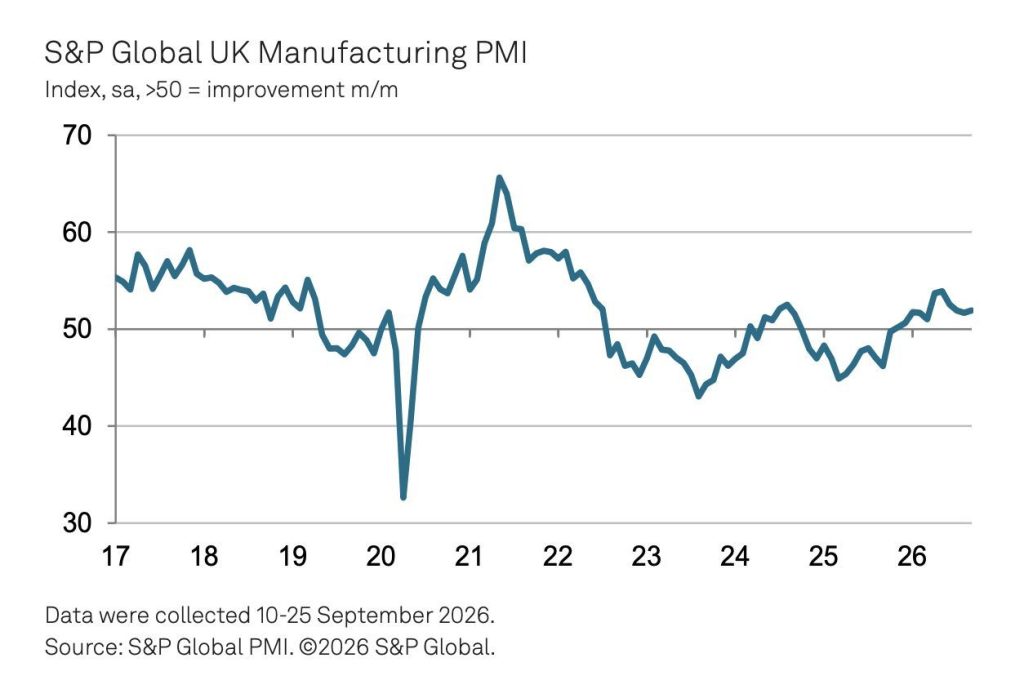
Measured overall, the volume of new business placed with UK manufacturers rose for the tenth month running and at a quicker pace than during August.
There were signs of widening performance disparities by sub-sector and company size, however. The latest increase in production was centred on the investment goods industry, which saw the fastest growth since the end of 2017, while contractions were seen in both the consumer and intermediate goods categories. Small manufacturers meanwhile saw production and new business contract sharply, contrasting with the growth registered at mediumand large-scale producers.
UK manufacturers maintained a positive outlook for the sector in September, with almost half of firms (49%) forecasting output to rise over the coming year. That said, the degree of confidence was slightly below August’s six-month high.
Reasons provided for positive sentiment included planned company expansions, new product launches, a hoped for rebound in market confidence and investment projects.
That said, several firms noted ongoing concerns about the geopolitical, macroeconomic and domestic policy outlooks.
Manufacturing employment rose for the sixth successive month in September, with the rate of job creation staying close to August’s two-year high. Staffing levels were raised to meet the dual needs of new order growth and increased backlogs of work. Outstanding business expanded for the second time in three months. Stocks of finished goods and purchases both declined, the latter despite increased input buying volumes.
Supply chains remained under noticeable stress during September, as highlighted by a further marked increase in average vendor delivery times. Supplier performance deteriorated to the greatest extent since June, reflecting the impacts of port congestion (domestic and international), shipping delays, geopolitical tensions and the resulting raw material shortages.
Stretched supply chains also exerted upward pressure on purchasing costs during September. The rate of input price inflation accelerated for the first time in four months, amid reports of higher costs for chemicals, electronics, energy and food stuffs. Geopolitical conflicts and rising transportation costs were also mentioned by several firms, with the latter often linked to increased diesel prices.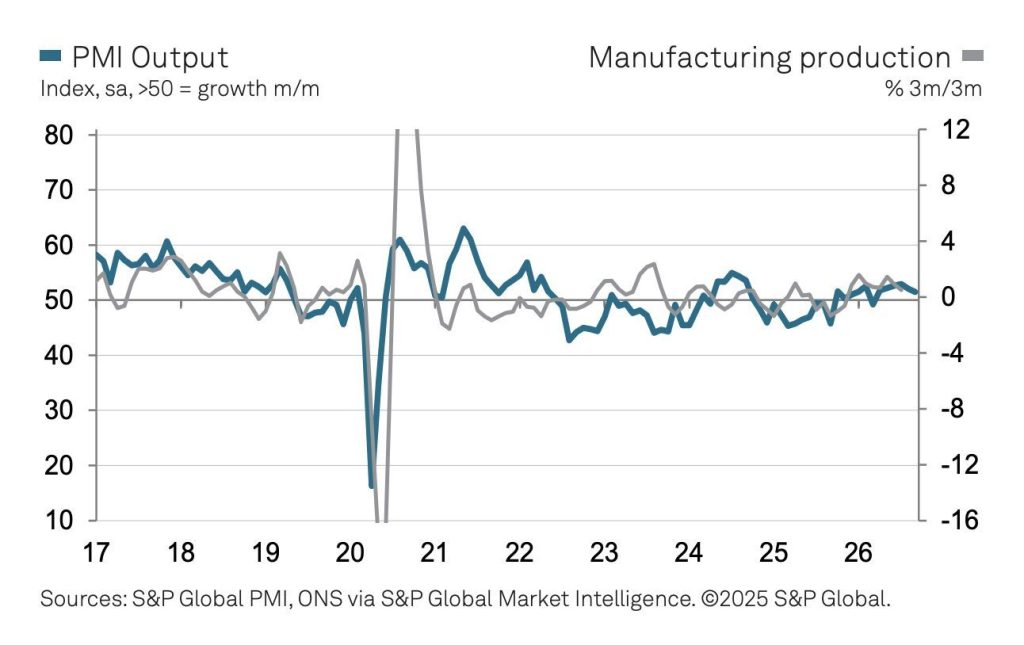
Average output charges were raised in response to the increase in costs. Selling prices have risen in each of the past ten months, with the rate of inflation strengthening in September. For both price measures (input costs and output charges), rates of increase were higher at SMEs than at largescale producers.
Commenting on the news, Rob Dobson, Director at S&P Global Market Intelligence, said: “A disappointing September PMI saw the rate of increase in UK manufacturing production slow further. Output growth was its weakest seen over the past six months, with orders and exports growing only modestly. Slower demand growth was to be expected given the higher energy prices seen during the month.
“The big shift in September was in the survey’s price measures, which switched from signalling a decline in inflationary pressures to a renewed uplift. After hitting conflict-driven highs earlier in the year, rates of increase in both input costs and factory gate selling prices accelerated for the first time since May. Energy and electronics prices remain especially elevated, while supply disruptions and rising diesel prices are now hitting transportation costs across industry. These price moves will be closely watched by the Bank of England for any signs of a more sustained and broader price uplift potentially taking hold.
“There are still some positive shoots of growth looking ahead, however, as manufacturers remain generally positive about the outlook. Almost half expect output to rise over the coming year. Confidence nevertheless remains subdued compared to that seen prior to the outbreak of the war in the Middle East, dampened not only by geopolitical issues but also reflecting uncertainty over policy direction at home. The upcoming Budget will therefore likely prove material in steering confidence.”
Graham FitzGerald, UK Head of Manufacturing at Lloyds said of the PMI news: “Manufacturers are continuing to seize opportunities for growth, with particularly strong demand in areas such as defence and food. This latest lift is especially positive at a time when elevated energy costs and supply-chain disruption continue to put pressure on margins.
“Firms remain focused on automation, plants and machinery that can help boost productivity and give firms greater control over costs. These investments will help improve long-term competitiveness, productivity and cost efficiency.”
Abu Ali, partner at FRP Corporate Finance, commented on the latest PMI: “Manufacturers appear to be moving up a gear after a strong September. Order books are holding up well in parts of the market, while businesses with greater financial flexibility are in a stronger position to pursue opportunities as they emerge.
“What’s particularly encouraging is that investment hasn’t ground to a halt. Manufacturers are still committing capital to plant, machinery and automation where there is a clear productivity or efficiency payoff. But with energy costs and supply chain disruption putting renewed pressure on margins, businesses are becoming much more selective about where they put their money.
“Our research shows manufacturing and industrial firms could unlock around £1.5bn in additional annual economic output by making key decisions more quickly. As firms plan investment into 2027, the challenge will be balancing that discipline with decisiveness – backing the opportunities that can strengthen productivity and competitiveness without waiting for perfect conditions.”
Commenting on the PMI, Matthew Jones, Founder of financial software firm OpenECX, said: “It’s clear that inflationary pressures are weighing on the manufacturing sector, so I’m not surprised to see growth slow down. When prices are higher, this has the knock-on effect of weaking consumer demand which restricts manufacturers’ ability to pass on those costs to customers, whilst geopolitical uncertainty also continues to put pressure on tight margins.”
“In such an unpredictable environment, manufacturers need to focus on managing the things they can control, and that should start with drive efficiencies in their own back office to help protect and maximise margins. Invoicing is a good example. Manufacturers often work across complex supplier networks, with large volumes of orders, deliveries and invoices moving between different businesses and systems.
“Errors caused by manual reporting or data entry mistakes can quickly lead to delays or payment disputes which can be a big operational headache. Getting the right tools in place to take that back-office burden away means businesses can spend more time focused on production. And unlike many of the external pressures facing the sector, these are improvements that will continue to deliver efficiencies in the long run.”
John Bryant, head of manufacturing at MHA, also commented on the PMI data: “UK manufacturing activity remains broadly flat, with the sector struggling to turn its natural optimism into meaningful momentum. Activity appeared to peak in the spring and early summer, likely supported by a degree of stockpiling, but has since fallen back. While the sector remains in positive territory, there now needs to be decisive action from government to support growth. Manufacturers want to invest and move forward, but high energy prices, rising employment costs and the continued complexity of exporting to the EU are weighing heavily on confidence.
“There are encouraging signs, including the Chancellor’s recent announcement on the new age of reindustrialisation and major investment announcements from companies such as Rolls-Royce and McLaren. These commitments can create a valuable knock-on effect throughout the supply chain. However, they sit alongside a much more mixed picture across the wider sector, including recent cuts announced by JLR.
“The Government’s Industrial Strategy is a positive idea in theory, but manufacturers now need to see more detail and delivery. Without clear incentives to unlock investment, there is a risk that the strategy simply sits on the shelf gathering dust.
“The upcoming Budget is an opportunity to change that. Businesses need practical measures that encourage capital investment, tackle persistently high energy and fuel costs, and provide greater certainty around skills. The apprenticeship levy also requires further work to ensure it reflects the realities of training people in the workplace.
“Manufacturing cannot remain flat indefinitely. Two years on, the sector still feels as though it is waiting for the announcement that will provide a genuine catalyst for growth. The Budget must help convert ambition into action and give manufacturers the confidence to invest, expand and strengthen supply chains.”
Mike Thornton, Head of Industrials at RSM UK, said: “Strong orders, increased purchasing activity, lower stocks of finished goods and another uptick in employment indicates manufacturers are moving in the right direction. This is further evidence that the overall sector growth, while modest, looks both sustainable and resilient.
“However, manufacturers are bracing for a challenging period. Sharp hikes in wholesale natural gas prices are expected to filter into electricity bills over the coming months, causing renewed concerns around cost pressures. Manufacturers won’t benefit from the VAT cut to electricity bills that has been introduced to households, so some will bear the full force of the price jump.
“The launch of the British Industrial Competitiveness Scheme today could provide qualifying businesses with much-needed relief of reduced energy prices. While this is a welcome measure for the sector, not all manufacturers will qualify. Expanding the scope is needed to support growth and ensure UK manufacturing can compete globally as it navigates the energy cost challenges expected to hit over the coming months.”
Thomas Pugh, chief economist at RSM UK, said: “The September PMI suggests that this years’ revival in the manufacturing sector has further to go. Manufacturing output is up 1.8% so far this year, its strongest period of growth in two years. The PMI data also suggests manufacturers have been increasing employment this year, a good sign of improving confidence.”
“However, the rise in the input and output prices balances suggests the latest wave of higher energy prices is feeding through into costs and will eventually feed through into higher goods prices across the economy. That combination of resilience and rising inflationary pressures makes it more likely that the Bank of England will hike interest rates in November.”