Manufacturers investing in automation are often told they face a binary choice. Either standardise and accept rigidity, or customise and absorb costs, complexity and long lead times. As product mixes widen, batch sizes shrink and schedules become less predictable, neither extreme delivers what modern workshops need. Instead, the most resilient automation strategies sit somewhere in the middle. Here, Hakan Aydoğdu, CEO at CNC automation specialist Tezmaksan Robot Technologies, explores how modular automation is helping manufacturers strike a balance between rigidity and flexibility.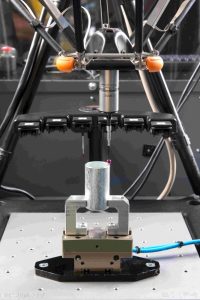
Across sectors like aerospace and general manufacturing, unpredictability has become the norm. Original equipment manufacturers (OEMs) are pushing variability down the supply chain and asking suppliers to handle more part numbers, tighter tolerances and faster changeovers, often without additional labour or more floor space.
According to Make UK, the UK’s leading manufacturers’ organisation, manufacturers are eager to automate their production, but they cite a lack of technical skills and labour availability as major barriers to effective deployment. Indeed, these challenges can affect automation utilisation as much as machine capability itself.
The Aerospace, Security and Defence Industries Association of Europe (ASD)’s annual Facts and Figures report for 2024 highlighted that labour and supply-chain bottlenecks continue to restrain aerospace manufacturing output, despite rising demand. Automation is an obvious response, but how automation is deployed matters just as much as whether it is deployed at all. Let’s examine some of the pitfalls of adopting automation.
When customisation becomes a constraint
For years, many automation projects were over-customised by default. Cells were engineered around a narrow set of parts, fixtures and workflows, optimised for a snapshot in time. But when demand shifts, those systems struggle. Every change to part geometries, material requirements or order profiles triggers re-engineering, new programming and downtime. Put simply, what was once a tailored solution becomes a limitation.
At the other end of the spectrum is fully standardised systems. These systems promise speed and cost control, but often lack the adaptability required on real shop floors. After all, CNC workshops rarely run identical parts and instead deal with mixed materials, variable cycle times and changing customer requirements. A rigid system that cannot accommodate this diversity risks being underused or even bypassed altogether.
The challenge, then, is not choosing between standardisation and customisation, but understanding where each approach makes the most sense.
Modular automation as the middle ground
What alternatives do we have to over-standardised or over-customised automation? One answer is modular automation. In other words, rather than choosing between standardisation and customisation, manufacturers can separate the two.
So, on the one hand, ‘core’ elements are standardised: robot arms, safety systems, interfaces and control software are selected as proven, repeatable modules. Around this stable core, customisation is applied where it adds value, such as in end-of-arm tooling, part handling strategies, pallet layouts and cell configuration.
This distinction is more than theoretical. Standardising ‘the core’ reduces engineering time and deployment risks with validated modules, familiar interfaces and faster commissioning. At the same time, flexibility around the core maintains responsiveness. Grippers can be swapped, fixtures adapted and cells.
Crucially, these changes do not require dismantling the entire system or rewriting the automation strategy from scratch.
For CNC machining, this approach aligns closely with how production actually evolves. For example, a shop may begin by automating loading and unloading for a single machine. As confidence grows, the same robotic platform can be extended to additional machines, longer unmanned runs or more complex part families. Incremental expansion becomes practical because the foundation is standardised.
Aerospace suppliers illustrate the value clearly. Many operate high-mix, low-volume environments with demanding quality requirements. Over-customised automation can lock them into inflexible cells, just as programmes ramp up or change.
Modular systems allow manufacturers to scale utilisation without the need for upfront overengineering, like designing bespoke cells for future volumes that may never materialise; they can spread investment while maintaining compliance and traceability.
This is where platforms like Tezmaksan’s CubeBOX, a modular CNC automation cell, and RoboCAM software can help manufacturers strike a balance between rigid and flexible automation.
Combining a standardised robotic cell architecture with configurable handling and software layers allows systems to evolve alongside production, rather than ahead of it. The aim is not to eliminate customisation from automation, but to place the systems where they deliver flexibility rather than fragility.
The key takeaway is that automation should never be viewed as a one-off project to merely solve today’s problems. Instead, automation’s capabilities must continually adapt as markets, materials and customer expectations change. Standardising core automation modules provides stability, while customised interfaces and tooling preserves agility. Together, they offer a route to future-proof CNC operations without the cost and risk traditionally associated with bespoke systems.
Manufacturers who recognise this middle ground are better placed to respond to uncertainty. Instead of making the binary choice of whether to standardise or customise, they can strike an effective and profitable balance between the two.
To learn more about how modular CNC automation balances standardisation and flexibility, visit Tezmaksan Robot Technologies’ website.
Read other recent UK Manufacturing news: https://uk-manufacturing-online.co.uk/category/news/