The UK manufacturing sector made a positive start to the second quarter of the year, with the trends in output, new orders and employment all showing signs of improvement. Supply chain and price pressures continued to grow, however, as disruptions, delays and the war in the Middle East were felt across the sector.
The seasonally adjusted S&P Global UK Manufacturing Purchasing Managers’ Index™ (PMI®) rose to a 47-month high of 53.7 in April, its best level since May 2022 and little-changed from the earlier flash estimate of 53.6. The headline PMI has posted above its neutral 50.0 mark – signalling expansion – for six successive months.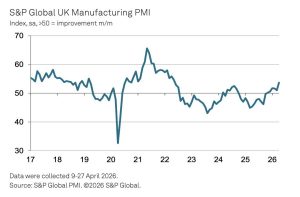
Four of the five PMI sub-components (output, new orders, employment and suppliers’ delivery times) were all at levels usually consistent with improved operating conditions. Stocks of purchases also declined to one of the weakest extents during its current 43-month sequence of contraction.
Manufacturing production rose for the sixth time in the past seven months. The scaling up of output volumes reflected improved new order intakes, efforts to clear backlogs of work and a minor build up of finished goods stocks. Output growth was broad-based by sector, with increases seen across the consumer, intermediate and investment goods categories.
Improved intakes of new work from domestic and overseas clients contributed to a fifth successive increase in total new orders in April, with the rate of expansion accelerating to one of its highest during the past four years. Part of the increase reflected clients bringing forward purchases to mitigate expected supply chain delays and price increases.
New export business rose for the fourth consecutive month, albeit to a slightly weaker extent than in March. Intakes of new work improved from clients in the USA, China, Japan, and India. There were, however, reports of new export order growth being stymied by the effects of Middle East conflict and restricted passage through the Strait of Hormuz on global economic expansion and client confidence.
Business optimism fell to its lowest level in a year during April, as manufacturers remained concerned about the impact of the war in the Middle East on global economic growth, geopolitical instability and the consequences of government policy. That said, companies still expect new product launches, planned marketing activity, improved client confidence and hopes for a more stable geopolitical backdrop to support output growth over the coming year.
Supply chain pressures continued to build in April. Average vendor performance deteriorated to the greatest extent in almost four years, linked to ongoing complications caused by the Middle East war and restrictions on transit through the Strait of Hormuz. Shortages of freight capacity, port disruptions and customs delays were also mentioned by manufacturers.
Supplier delays and the resulting shortages of inputs led to a further steep acceleration in purchase price inflation during April. Input costs increased at the quickest pace since June 2022 and to one of the greatest extents registered by the survey (which began in January 1992) outside of the postpandemic inflationary surge.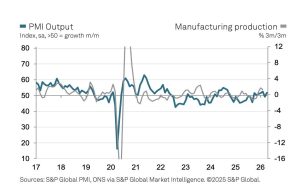
Manufacturers reported a wide range of inputs as up in price, including chemicals, electronics, energy, food stuffs, metals, plastics, pulp and timber. The feed-through of higher taxes and staff costs (employer NI and minimum wages) also contributed to higher purchasing costs. Subsequently, manufacturers raised their average selling prices for the fifth successive month and at the fastest rate since November 2022.
Purchasing activity rose for the first time in three months in April, as some firms stepped up input buying to mitigate expected price increases and supply disruption. Stocks of purchases fell only marginally, while there was a mild build-up of finished goods inventory.
Rob Dobson, Director at S&P Global Market Intelligence, said of the PMI: “April saw the growth rate of the UK manufacturing sector recover after being hit by the impacts of the war in the Middle East during March. The headline PMI rose to a near four-year high, as the trends in output and new orders strengthened. Staffing levels were also increased for the first time in 18 months.
“The upturn comes with several of catches, however. Restrictions on transit through the Strait of Hormuz are causing substantial disruptions to input deliveries, with supplier lead times lengthening to the greatest extent in almost four years. The resulting material shortages are exerting steep pressure on purchasing costs. Input prices rose at one of the fastest rates in the 34-year survey history, and at a pace rarely exceeded outside of the pandemic-related inflationary surge of 2021-22.
“It should also be noted that the gain in production is partly the result of clients bringing forward purchases to mitigate expected price uplifts and supply disruptions. As this process unwinds later in the year, alongside declining business optimism, growth in the sector could cool while inflationary pressures remain on high heat.”
Commenting on the latest PMI, which has increased to 53.7 in April, from 51.0 in March, Mike Thornton, Head of Industrials at RSM UK, said: “Strong headline manufacturing PMI figures, jumping to 53.7 in April, shows surprising resilience again despite the middle east crisis. There are also clear signs of positivity in terms of employment with the index tipping above 50 for the first time since significant employment cost increases were announced in the Autumn Budget 2024. Notwithstanding the geopolitical situation, it’s reassuring to see that order intake, both domestic and export, has held firm.
“On the flip side, the input price index has surged upwards. This squeeze will be hitting the margins of manufacturers over the coming months and working capital requirements will increase. The output price increase has increased already, perhaps indicating that manufacturers are now more agile when it comes to passing the increased cost burden onto customers.
“Middle market manufacturers are likely to be more exposed to volatility in energy costs than larger firms, which are typically better hedged. This difference could accelerate consolidation across the sector as sustained input‑cost pressure squeezes the wider supply chain – giving bigger manufacturers a competitive advantage.
He added: “If the conflict in the Middle East continues, we are likely to see energy costs weigh heavily on industry. Accelerating the introduction of the British Industrial Competitiveness Scheme (BICS) is a step government could take now to reduce electricity costs when industry needs it most.”
Thomas Pugh, chief economist at RSM UK, said: “The rebound in the output balance of the Manufacturing PMI suggests that production held up in April despite the war in Iran. Admittedly, much of that resilience is due to activity being brought forward ahead of price rises and potential supply shortages. This means growth is expected to slow sharply in Q2, even if April is stronger than expected, as higher energy prices start to eat into real incomes and margins.
“At the margin, surging input and output price balances alongside rising output suggests that the MPC may have more room to raise rates than initially thought, especially as the employment balance turned positive for the first time since October 2024. However, as front-running fades we expect output to drop sharply. Indeed, the future output index dropped to its lowest level in a year suggesting that recent momentum won’t last much longer.
“Ultimately, everything depends on how energy prices move going forward. If demand holds up, then second round effects are more likely and shift the MPC’s focus towards returning inflation to target. In any case, the longer the crisis continues the more likely it is that demand will weaken. This leaves the economy in another bout of stagflation which the Bank will probably balance by staying on hold this year, but the risks are clearly skewed towards rate hikes.”
Chris Barlow, head of manufacturing at MHA, comments on today’s S&P manufacturing PMI data: “April’s manufacturing PMI activity exceeded market expectations suggesting that for the moment the sector is dealing well with a challenging situation. That increase is likely to be the result of firms bringing forward orders and building up stocks as tensions remain in the Middle East and worries remain over energy supplies and the closure of the Strait of Hormuz.
“In the near term the bigger concern is that supply chains are starting to creak again with longer delivery times, parts shortages and wider transport delays quickly hitting output, even if demand is so far holding up.
“If DHL logistics workers contracted to JLR go ahead with their planned indefinite strike in early May, this will cause additional disruptions, potentially leading to further setbacks in manufacturing activity later in the spring. With the addition of soaring fuel and freight costs, manufacturers could be pushed back into stop-start production as they protect inventories and have less room to absorb shocks.
“The PMI may still point to expansion, but the next few months are going to be bumpy until there is more certainty on fuel prices and supply. That is why the Government is under pressure to move faster on relief. Rachel Reeves has promised to widen the British Industrial Competitiveness Scheme, which aims to cut electricity bills for around 10,000 manufacturers by up to a quarter. But with the main support not due to arrive until next year, even if it is backdated, many firms will argue it does not help with the immediate squeeze from higher energy, fuel and shipping costs.”
Read other recent UK Manufacturing news: https://uk-manufacturing-online.co.uk/category/news/