The UK manufacturing sector registered faster expansions of output and new orders at the start of the fourth quarter, according to the seasonally adjusted S&P Global UK Manufacturing Purchasing Managers’ Index (PMI). The outlook for industry also strengthened, with confidence about the year ahead rising to an eight-month high. The news on supply chains and price pressures was less reassuring, with input cost inflation accelerating and vendor lead times lengthening to one of the greatest extents in four years.
The PMI rose to a five-month high of 52.8 in October, up from 51.9 in September and unchanged from the earlier flash estimate. Data were collected between 12-27 October, meaning the survey closed before the UK Autumn Budget statement on 28 October.
Three of the five PMI components were at levels consistent with an improvement in overall operating conditions, with output and new orders rising and suppliers’ delivery times lengthening. Stocks of purchases fell further, while employment was unchanged following a six-month sequence of job creation.
Manufacturing production rose for the seventh successive month in October, with the rate of expansion hitting a 25-month high. Companies responded to improved intakes of new business and stronger market conditions. The expansion was broad-based by sub-sector, with growth signalled across the consumer, intermediate and investment goods industries. The strongest rate of increase was in the investment goods category and the weakest in intermediate goods.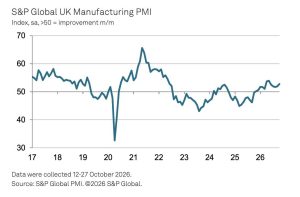
October saw the upturn in new business gather pace, with new work intakes rising at the fastest rate since July. Manufacturers reported improved demand from both domestic and overseas clients. New export business rose for the tenth month in a row, led by growth in sales to Brazil, mainland China, the EU, the Middle East and US.
The continued upturn in manufacturing output and new orders had limited impact on the labour market in October. Staffing levels were unchanged, halting a six-month sequence of jobs growth. Some firms continued to hire additional workers in response to increased production requirements, while others focussed greater attention on delaying capacity increases to offset rising labour, transport and raw material costs.
Input costs rose for the thirty-fourth month in a row. Moreover, the rate of inflation was one of the sharpest during the past four years (beaten only by the rates reached during March-to-June of this year).
Companies reported a wide range of inputs as up in price, including energy, fuels, transportation, electronics, chemicals and metals. Part of the increase in costs was passed on to clients in the form of higher selling prices. Output charges rose at the quickest pace in three months.
Business optimism rose to an eight-month high in October. Manufacturers linked their optimistic outlook to planned business expansions, signs of market recovery, spending on capital equipment and AI (including data centres), new product launches and better order pipelines. Several firms raised concerns about possible government policy changes and the high-cost environment.
Rob Dobson, Director at S&P Global Market Intelligence, comments: “UK manufacturing showed resilience in the lead up to the Autumn Budget. Rates of growth in output and new orders both gathered pace in October, as companies responded to signs of improving demand in both domestic and overseas markets, including new work received from mainland China, the EU and the US.
“Concerns about possible policy changes filtered through to the labour market, however, with the upturn in employee numbers halting following a six-month sequence of increased hirings. The remainder of 2026 will see if the confirmed rise in the minimum wage for next year will continue to weigh on employment trends.
“Rising labour costs are also coming at a time when the cost environment is already generally high. As well as higher wage costs, manufacturers are being buffeted by rising fuel, energy and transportation costs as supply chain shocks and delays continued to drive up inflationary pressures. Input prices consequently rose to one of the greatest extents in the past four years in October which, alongside the signs of resilience in the manufacturing sector, will further shorten the odds of interest rate hikes to come from the Bank of England.”
Chris Barlow, partner at MHA, comments on today’s S&P manufacturing PMI data: “The rise in PMI activity is a positive sign that manufacturers are seeing light at the end of the tunnel, as growth in output and new orders has strengthened. However, the conflict in the Middle East is increasing fuel costs and causing supply chain delays, while the war in Ukraine continues to disrupt energy and raw material supplies. These pressures make it harder for manufacturers to plan, invest and compete.”
“Rolls-Royce’s engine development announcement last week is a welcome sign of the Government’s ambition to reindustrialise Britain. However, one major project does not constitute a plan for the whole sector. The Chancellor’s maiden Budget offered little else for manufacturers already grappling with higher National Insurance costs and expensive energy.”
“The extending to the BICS Energy relief is welcome, but complex eligibility rules risk leaving businesses behind. Reindustrialisation needs more than headline announcements: manufacturers of every size need clearer support on energy costs, tariffs and EU trade. The Government must dust off the Industrial Strategy and turn ambition into practical incentives that give businesses the confidence to invest and grow.”
Graham FitzGerald, UK Head of Manufacturing at Lloyds: “UK manufacturing continues to grow, with stronger momentum providing a more positive backdrop for businesses looking to invest and expand.
“Last week’s Budget included some measures that could ease cost pressures for some energy-intensive manufacturers, while increased defence investment has the potential to create new opportunities across UK supply chains. If those benefits reach businesses of all sizes, particularly smaller firms further down the supply chain, they could provide a boost to confidence, investment and growth as we head into 2027.”
Read other recent UK Manufacturing news: https://uk-manufacturing-online.co.uk/category/news/