Managing fume and gaseous organic compound emissions has long been important in electronics manufacturing. Effective fume extraction helps electronics manufacturers protect their equipment, support product quality, and maintain a clean workplace environment. However, in recent years the growing complexity of microelectronics, coupled with the miniaturisation of components, has intensified the need for precision air quality control. Even microscopic contamination can result in solder joint failures, short circuits, or diminished performance.
The demand for speed places greater emphasis on automation and the integration of all the constituent parts of the manufacturing process. For fume and dust extraction systems, this means investing in technical innovations that deliver an airflow management and filtration architecture that can capture emissions effectively, while stretching the periods between filter exchanges. This will help electronics manufacturers to minimise downtime while increasing operations efficiency and controlling costs.
Electronics manufacturers must also now take into account Industry 4.0 considerations as portable fume extraction solutions are helping to provide enhanced support and greater flexibility against the demands of more agile manufacturing approaches. Portable systems are far more manoeuvrable than their fixed counterparts, providing flexibility that accommodates changes to the factory floor. Their ability to be quickly repositioned to support evolving layouts, without the need for major infrastructure changes, is a significant advantage in an Industry 4.0 environment.
Soldering fume extraction
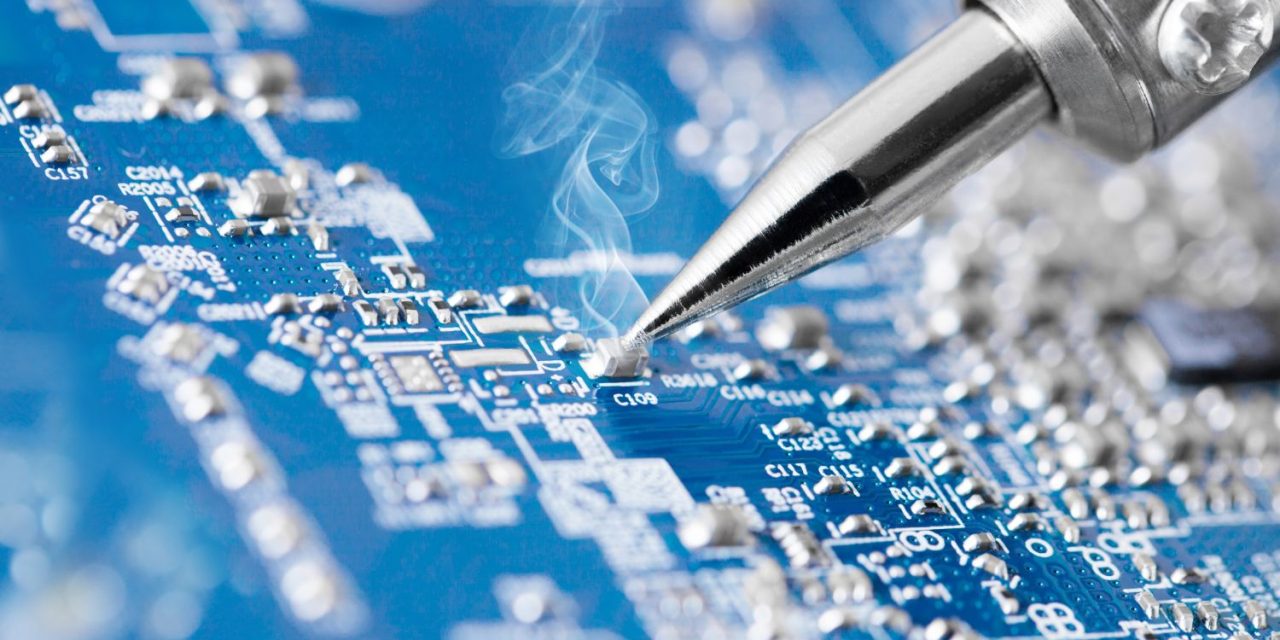
In wave soldering, PCB components are placed on the board and passed over a continuous wave of molten solder. Areas not to be soldered are covered with a protective ‘mask.’ While this process doesn’t usually involve the potentially harmful resin/colophony present in hand soldering, it can require the use of an alcohol-based solvent such as Isopropyl Alcohol (IPA) and a small amount of organic acid, fume from which needs to be filtered. Before soldering, the boards are ‘spray fluxed’, using either a general spray process, which can generate airborne dispersions of flux particulates and vapours, or a targeted jet from a robotic nozzle.
With reflow soldering, solder paste is applied to the PCB and components are ‘picked and placed’. The board moves through various heating, stabilising and cooling zones, during which the solder metal ‘reflows’ or melts and solidifies around the component connection. During this process, the solvent that makes the paste liquify will evaporate. All of these airborne emissions need to be filtered through a fume extraction system.
A temperature control unit (TCU) can help maintain optimal PCB print area temperatures in automated production lines. This is crucial for solder reliability, component placement accuracy, defect reduction, and production consistency. Even small deviations can lead to major yield loss or reliability issues in electronics manufacturing.
Process assessment
To achieve these goals, air filtration engineers should undertake a detailed assessment of the industrial process, the materials being worked, and the volume and composition of the fume or particles being emitted. This should include detailed mapping of the airflow management parameters, to set the correct capture velocity (the speed of suction) that is required to satisfy local emissions regulations. These desktop analytics should then be proven through a process of application testing, to underscore the anticipated benefits with rock-solid performance data.
The resulting fume and particulate extraction systems should be tailored to specific workplace exposure limits set under the Control of Substances Hazard to Health (COSHH) regulations. One filter media to consider is HEPA filters as they provide a very high level of filtration for both the smallest and largest particulate contaminants. They send air through various pre-filters to assist with catching airborne particulate, capturing 99.995% of particles at 0.3 microns, as per the European standards.
Smarter fume extraction
The selection of appropriate filter media is only one part of achieving optimal air quality control. Advances in connected filtration technology are also transforming the way electronics manufacturers monitor and manage their extraction systems. They provide IoT, sensor-based monitoring to track filter performance in real time. Alerts provide actionable data on pressure differential, airflow and system health. Automated compliance reporting and remote performance insights are also highlighted via an online dashboard.
This type of predictive maintenance capability can help production teams anticipate filter replacement needs before performance is compromised, reducing unplanned downtime and supporting continuous production. Rather than relying on fixed maintenance schedules, manufacturers can base servicing decisions on actual system data, optimising both filter life and operational efficiency.
Smart systems such as these are compatible with most major dusts collector brands and require no IT integration. This data-driven approach aligns closely with the broader goals of Industry 4.0, where connectivity and intelligent monitoring are central to smart, more responsive manufacturing environments. This allows electronics manufacturers to implement condition-based maintenance programmes and reduce operating costs, supporting more efficient, responsive production environments.
Industry 4.0 agility
For many years, the standard approach to manufacturing fume extraction was to use a centralised/fixed or vent-to-air exhaust system. As electronics manufacturers must now adapt to the agile demands of Industry 4.0, portable fume and dust extraction systems are increasingly becoming a feature of automated electronics production processes. This includes processes such as wave and reflow soldering in factories producing high-volume, high-quality PCBs. Portable filtration supports a ‘make anything anywhere’ production culture. It is simple for production teams to set up with minimal disruption, and it can be scaled progressively to meet demand.
The quick and flexible deployment of portable fume extraction systems means that installation and maintenance costs tend to be lower. In contrast, a vent-to-air system requires a greater initial investment due to the need for a larger-scale, centralised infrastructure. This involves complex ducting and pipework, which not only adds to the initial cost but can also make future changes to the factory floor layout more expensive and time-consuming.
Traditional vent-to-air systems expel both air and fumes outside, which can increase energy consumption as heated or cooled air must be continuously removed from the workplace. However, portable systems recirculate filtered air back into the workplace, which helps to retain heated air within the building and reduces the need for it to be replaced with cold outside air. Consequently, energy consumption for space heating can be lower for portable fume extraction systems.
Optimum combination
While portable systems offer significant flexibility, it is important to remember that a fixed or centralised vent-to-air system might be better suited to certain applications. This includes large-scale industrial processes where centralised systems are designed to handle the emissions from multiple stations or processes, which can be more efficient for large installations. They are also central to the prevention of line contamination, as a centralised vent-to-air system removes potentially harmful airborne contaminants, reducing the risk of particles settling on production equipment, which could potentially damage product quality.
Also, for high-volume and stationary process situations that are not expected to change, a fixed system can provide a robust and permanent solution to ensure consistent fume removal where there is no need for frequent repositioning.
However, it is not necessarily a ‘one size fits all’ option, as portable and fixed fume extraction solutions can be combined effectively to optimise production. Portable systems can be used to augment an existing vent-to-air (VTA) system, addressing specific processes or workstations that may not be a good fit for the main centralised exhaust.
This dual functionality is particularly useful in agile manufacturing environments where a business might use a fixed VTA system as a base but also needs the flexibility of portable units. This can help businesses adapt to changing production layouts and processes without incurring any significant costs and downtime associated with modifying a fixed, centralised infrastructure. This multi-layered approach creates a more flexible and comprehensive fume extraction strategy in the factory environment strategy.
Effective air management
Effective fume and particulate extraction play an important part in helping electronics manufacturers create a clean environment for their teams while maintaining high levels of quality and productivity. Such a system will contribute to optimal automated electronics manufacturing performance through effective air management and multi-stage filtration technology. This now increasingly includes Industry 4.0 considerations, where portable fume extraction solutions are proving to deliver enhanced support through greater flexibility in an agile manufacturing setting.
However, portable solutions can also be deployed to effectively support more traditional fixed fume extraction systems. This will enable manufacturers to optimise investments already made in factory processes, infrastructure and equipment, while taking advantage of new smart factory approaches that enhance production, minimise downtime and eliminate inefficiencies.
Alongside fume and particulate extraction, venting solutions play an increasingly important supporting role in electronics manufacturing environments. As devices continue to shrink and enclosures become ever more compact, the need to protect sensitive electronic components from pressure differentials, moisture and particulate ingress has grown considerably.
Specialist venting solutions allow pressure equalisation whilst maintaining a barrier against contaminants, which is particularly relevant in automated production lines. Achieving consistent air quality across all aspects of electronics production therefore demands a comprehensive, consultative approach, drawing on expertise that spans filtration assessment, system design, filter media selection and ongoing performance monitoring.
Author: Arran Morgan, Product and Engineering Director at Donaldson BOFA, which designs, develops and manufactures portable fume and dust extraction solutions for a wide range of industrial sectors and applications across the world.
Read other recent UK Manufacturing news: https://uk-manufacturing-online.co.uk/category/news/