The upturn in the UK manufacturing sector cooled slightly in August according to the S&P Global UK Manufacturing PMI, as rates of growth in both output and new orders lost momentum. The outlook showed greater signs of positivity, however, as business optimism rose to a six-month high. There was also better news on the costs front, as average purchase price inflation slowed for the third consecutive month.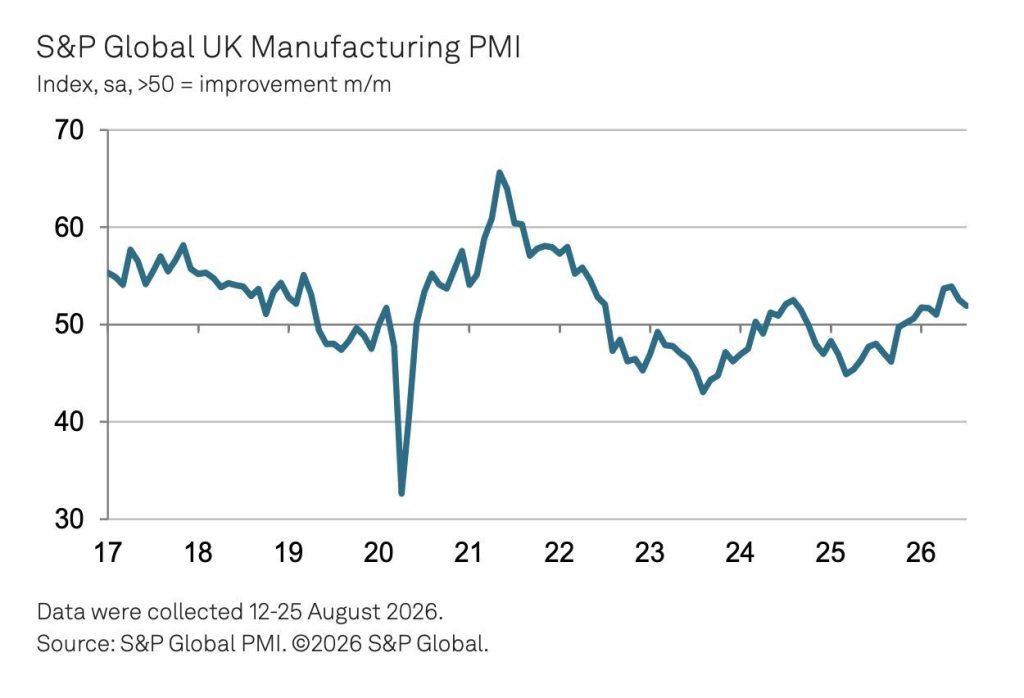
The seasonally adjusted S&P Global UK Manufacturing Purchasing Managers’ Index™ (PMI®) fell to a five-month low of 51.7 in August, down from 51.9 in July but above the earlier flash estimate of 51.5. The PMI has posted above the neutral 50.0 mark separating expansion from contraction for ten months in a row.
Four of the five PMI subcomponents were at levels consistent with an improvement in operating performance during August. Output, new orders and employment all rose and suppliers’ delivery times lengthened. In contrast, stocks of purchases fell for the third month in a row.
UK manufacturing output rose for the fifth successive month in August, although the rate of growth eased to its weakest since April. Higher levels of production were underpinned by increased intakes of new work, with demand from both domestic and overseas clients improving.
There were signs of performance disparities between different sub-industries and company size types. Small-scale producers saw output and new order intakes decline, in contrast to the expansions seen at medium- and large-sized manufacturers.
The investment goods sector fared best in August, registering the steepest growth of both production and new orders. Rates of expansion also hit 24- and 51-month highs respectively. In contrast, output growth slowed to a four-month low in the intermediate goods category, while consumer goods production fell for the first time in three months. Both sectors also experienced declining inflows of new work received.
The level of new export business rose for the eighth month running in August, as overseas demand for UK manufactured consumer and investment goods improved. There were reports of increased new order intakes from mainland China, the US, the Middle East and western Europe.
The ongoing upturn in the UK manufacturing sector filtered through to the labour market and business confidence. Employment rose for the fifth consecutive month and at the quickest pace for two years.
Jobs growth was linked to rising production requirements, improved new order intakes and efforts to clear backlogs of work. There were reports of increased hiring of both full and part time employees. Backlogs of work decreased following a mild increase in the prior survey month.
Optimism regarding the year ahead outlook for the UK manufacturing sector rose to a six-month high in August, with almost 50% of surveyed companies expecting their own level of production to be higher 12 months from now. Optimism reflected expected sales growth, improving market conditions, reduced geopolitical uncertainty, lower trade tensions and planned investments in capital equipment, technology, new products and marketing. That said, a number of companies raised concerns about ongoing cost pressures, the economic outlook and the possible direction of UK government policy.
There was better news on cost and supply fronts during August. Although manufacturers continued to face high purchase price inflation and supply-chain disruptions, there were further signs of these pressures moderating.
Average input costs rose for the thirty-second successive month, but the rate of inflation eased to its weakest since February. Factory gate selling prices also rose during the latest survey month. Average supplier lead times lengthened to the least marked extent for six months.
Rob Dobson, Director at S&P Global Market Intelligence, commented: “The rate of expansion in the UK manufacturing sector cooled in August, with output and new order growth losing traction. There are still signs for continued optimism, however, as manufacturers reported a positive outlook for the year ahead. Business confidence rose to a six-month high and job creation was the strongest for two years. This suggests that the slowdown was mainly driven by a reduced focus on maintaining precautionary stocks as economic uncertainty eases, especially as domestic and overseas clients continue to show a willingness to spend albeit with a relatively high degree of caution.
“Although cost and supply chain pressures remain potentially damaging, there was better news on these fronts too. Volatility in energy markets, supply constraints, geopolitical strife and transportation disruptions are all keeping cost rises at elevated levels, but August at least saw purchase price inflation descend from recent peaks to a six-month low. Supply chain delays were the least marked for six months too, which should provide additional respite to cost pressures barring any further major disruptions.”
Emily Sawicz, director and industrials senior analyst at RSM UK, commented on the PMI data: “Today’s PMI data points to a manufacturing sector that remains in moderate expansion, with improving demand conditions helping to stabilise activity after growth slowed through the summer. However, the pace of expansion remains relatively modest by historical standards.
“Manufacturers are benefiting from areas of structural demand, including investment linked to data centre construction and wider infrastructure projects. At the same time, lower supply chain disruption is reducing some of the operational pressures that businesses faced earlier in the year. These factors should help to support production levels heading into the second half of 2026.
“Despite expected improvement, there are still clear headwinds impacting the sector. The inventory building and front-loading that boosted activity in April and May continues to unwind, while export markets remain challenging amid global trade uncertainty. Higher labour costs, elevated input price inflation and a weakening UK labour market are also likely to weigh on confidence and investment decisions.
“A reading of 51.7 would signal that the sector remains on a positive trajectory, but the moderation from May’s peak suggests manufacturers are entering a period of steadier, slower growth. The key question for the rest of the year is whether improving domestic demand and investment can offset ongoing pressure from exports, costs and ongoing geopolitical uncertainty.”
Thomas Pugh, chief economist at RSM UK, said of the latest PMI data: “The upwards revision to the manufacturing PMI is further evidence that the current resurgence in the sector is about more than just restocking ahead of disruptions from the Iran war, which in turn boosted the employment balance to a two-year high.
“Admittedly, the second half of the year is likely to be tougher. Natural gas prices continue to grind up, with the stock of natural gas at their 10-year minimum, the potential for further price rises is obvious. Inflation will also rebound to 3.7% later this year, which will prompt real household incomes to stagnate crimping demand for consumer goods.
“However, underlying demand should be relatively resilient, with the PMI showing that new orders in the capital goods sector reached a 51-month high, likely as AI investment continues and defence spending across the world ramps up. For Andy Burnham, the challenge is following up on big ideas of stronger defence spending and reindustrialisation with tangible policies that will boost growth.”
Read other recent UK Manufacturing news: https://uk-manufacturing-online.co.uk/category/news/