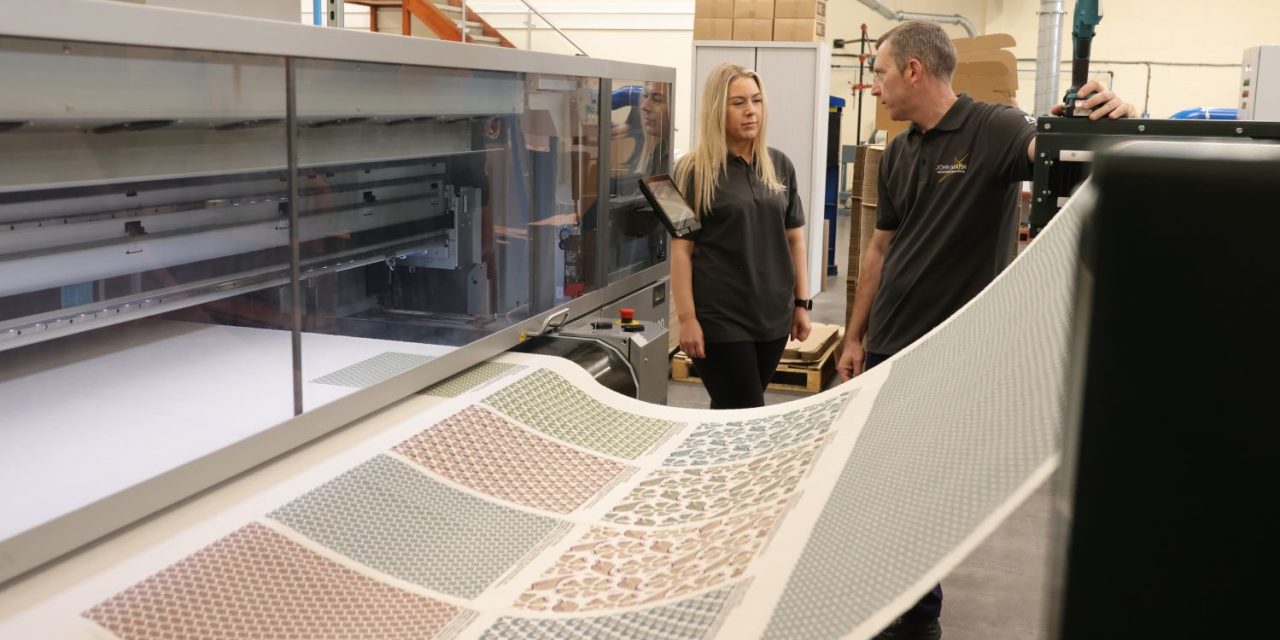
For 14 years, John Mark has built its reputation as a commissioned printer, producing wallcoverings for leading international names and hundreds of boutique brands. Customers repeatedly asked the company to produce coordinating fabrics as well, so they could use a single supplier.
Many of John Mark’s customers sell more fabric than wallpaper, and the company already had the relationships, colour expertise and quality control processes needed to support them. Moving into textiles, however, had previously meant adopting a much more complex production process.
John Mark, the company’s founder, explains: “Whenever I looked into fabric printers, I saw all the separate equipment and processes needed for pre-treatment, printing, post-treatment and finishing. The investment and complexity were far greater than we could take on. There was no machine that gave us the straightforward workflow we were looking for.”
The Epson solution
That changed when John Mark visited Epson’s UK Innovation Centre and learnt about the Monna Lisa ML-13000. The direct-to-fabric printer combines pre-treatment, pigment printing and post-treatment in one machine, removing the need for separate treatment stages.
The process closely resembled John Mark’s established wallcovering workflow: load the material, calibrate the printer and print, with less handling to produce a finished result. After seeing the ML-13000 demonstrated in Paris, the team chose it for the move into fabric printing. John Mark became the first UK business to install the model.
“It did everything in one, which was exactly what we wanted,” says John Mark. “The print quality, depth and strength of colour were impressive. We had looked at the market over many years, but this was the first solution that made entering textiles work for our business.”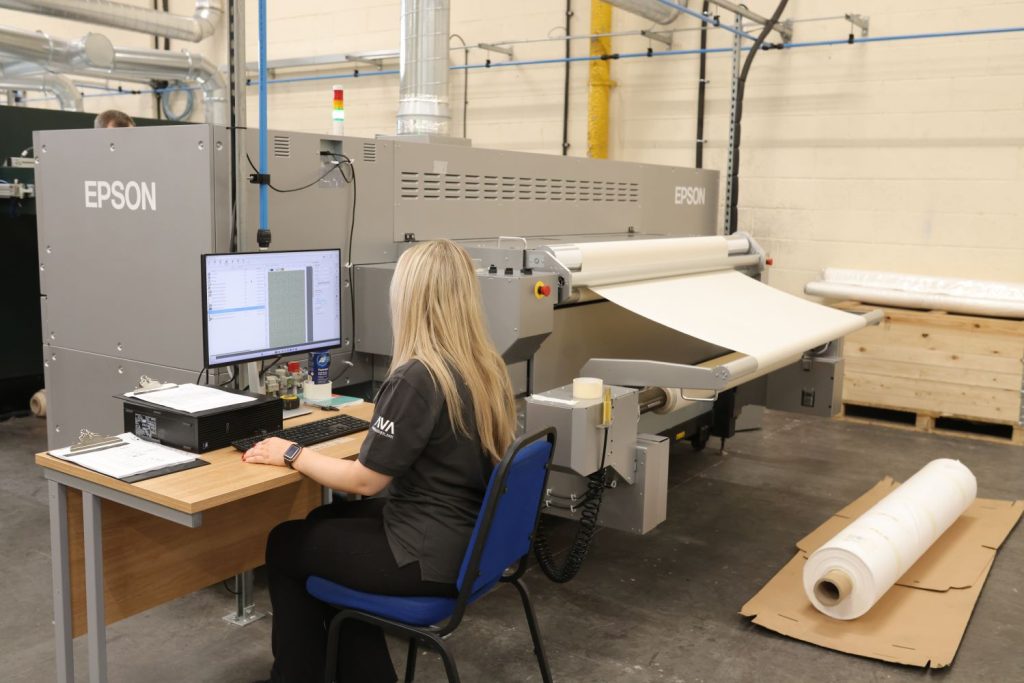
Hardware and set-up
The ML-13000 was installed at John Mark’s Leyland factory alongside an electric curing oven. Epson’s engineers connected the two systems and completed the installation.
“There were no hitches,” says John Mark. “Once the oven was installed, Epson’s team got it communicating with the printer, and everything worked very well. It did exactly what it said it was going to do.”
The company spent the first three to four months testing materials, refining its processes and building a specialist team before moving into full production. This gave operators time to learn how to use the machine and apply the same quality standards as in the wallcovering operation.
Colour management is central to the process. John Mark uses its AVA workflow and an X-Rite i1Pro 3 spectrophotometer to calibrate and profile each fabric. Once approved, the profile becomes the standard for that material. The studio can then apply the relevant fabric profile to existing wallpaper artwork to achieve a close colour match across coordinating wallpaper and textile collections.
Performance to date
Early customer trials reinforced John Mark’s decision to invest in the Monna Lisa. The company supported customers whose previous mill had gone out of business. The work involved sampling, colour matching and converting collections containing up to 200 colourways. The team has since begun fulfilling approved production orders.
Customers have responded particularly well to the colour reproduction and feel of the printed linen. Because the treatment solutions are applied only to the printed areas, the finished fabric retains the soft feel customers expect.
Customers can now source wallcoverings and fabrics from one supplier, with consistent colour management across both. John Mark is already considering a second ML-13000 as demand grows.
John Mark concludes: “We don’t regret our decision to choose Epson. The machine has lived up to our expectations and certainly does the job. We now feel confident that the team, materials and processes are ready, and we can really take this offer to the market.”
Read other recent UK Manufacturing news: https://uk-manufacturing-online.co.uk/category/news/