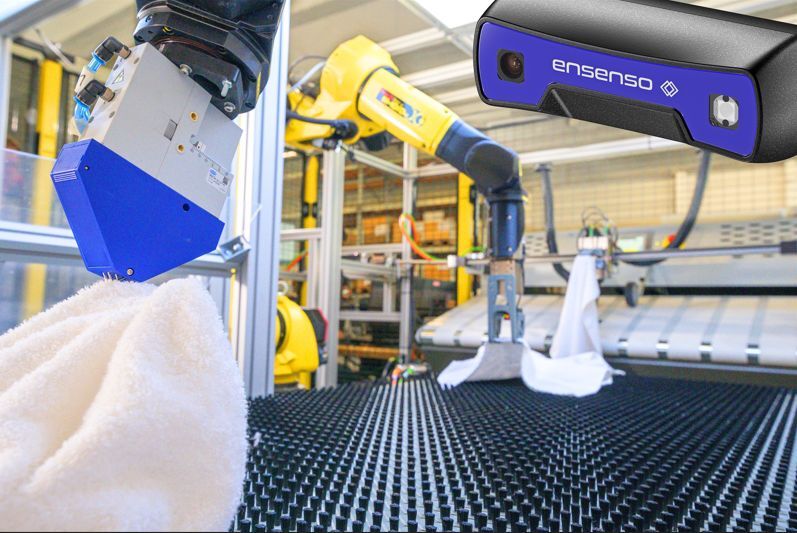
The textile and garment industry is facing major challenges with supply chain and energy issues. The future recovery is also threatened by factors that hinder production, such as labour and equipment shortages, which put them under additional pressure. The competitiveness of the industry depends on how affected companies respond to these conditions. One solution is to move the production of clothing back to Europe. Shorter transport routes and significant savings in transport costs and greenhouse gases would favour of this. On the other hand, higher wage costs and the prevailing shortage of skilled workers in this country must be compensated.
The German deep-tech start-up sewts GmbH has focused on the great potential that lies in the automation of textile processing. It develops solutions with the help of which robots – similar to humans – anticipate how a textile will behave and adapt their movement accordingly. In the first step, sewts has set its sights on an application for large industrial laundries. With a system that uses both 2D and 3D cameras from IDS Imaging Development Systems, the entrepreneurs are automating one of the last remaining manual steps in large-scale industrial laundries, the unfolding process. Although 90% of the process steps in industrial washing are already automated, the remaining manual operations account for 30% of labour costs. The potential savings through automation are therefore enormous at this point.
“The particular challenge here is the malleability of the textiles,” explains Tim Doerks, co-founder and CTO. While the automation of the processing of solid materials, such as metals, is comparatively unproblematic with the help of robotics and AI solutions, available software solutions and conventional image processing often still have their limits when it comes to easily deformable materials. Accordingly, commercially available robots and gripping systems have so far only been able to perform such simple operations as gripping a towel or piece of clothing inadequately. But the sewts system VELUM can provide this. With the help of intelligent software and easy-to-integrate IDS cameras, it is able to analyse dimensionally unstable materials such as textiles. Thanks to the new technology, robots can predict the behaviour of these materials during gripping in real time. It empowers VELUM to feed towels and similar linen made of terry cloth easily and crease-free into existing folding machines, thus closing a cost-sensitive automation gap.
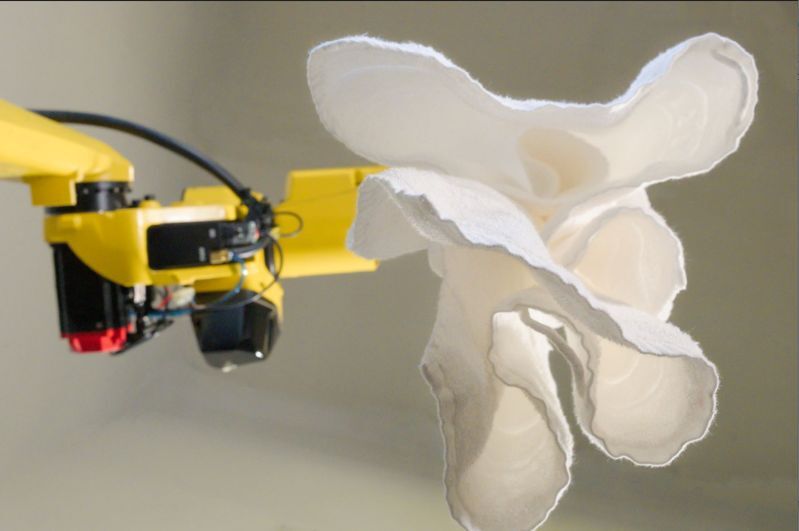
“We need a 3D camera that is cost-effective because we use two to three 3D cameras depending on the system configuration. In addition, it must above all ensure high accuracy of the depth data,” describes Tim Doerks. “Beyond that, we need 2D cameras that are light sensitive, deliver high dynamic range and are suitable for use in a multi-camera system.” The founders found what they were looking for in the IDS portfolio: For the VELUM multi-camera system, the choice fell on the new Ensenso S10 3D camera as well as models from the uEye CP camera series. Their task is to identify, both in 2D and 3D, interesting features and gripping points of the textiles that are fed into the system after washing and drying in an unordered manner in a container or on a conveyor belt. The shape and position of the individual objects cannot be predicted. The cameras capture the different textures of the materials. They distinguish which hems there are on a towel and where corners are.
“We match the images from the 2D and 3D cameras to have a higher 2D resolution together with the 3D data. So we use the respective advantages of the 2D camera, in this case the higher resolution, and the 3D camera, i.e. the precise depth data.” Equipped with a 1.6 MP Sony sensor, the Ensenso S10 uses a 3D process based on structured light: A narrow-band infrared laser projector produces a high-contrast dot pattern even on objects with difficult surfaces or in dimly lit environments. Each image captured by the 1.6 MP Sony sensor provides a complete point cloud with up to 85.000 depth points. Artificial intelligence enables reliable assignment of the laser points found to the hard-coded positions of the projection.
The complementary uEye CP industrial camera from IDS Imaging Development Systems delivers near-noise-free, high-contrast 5 MP images. It offers maximum functionality with extensive pixel pre-processing and is perfect for multi-camera systems thanks to the internal 120 MB image memory for buffering image sequences. At around 50 g, the small magnesium housing is as light as it is robust and predestines the camera for space-critical applications and for use on robot arms.
With systems like VELUM, laundries can significantly increase their throughput regardless of the staffing situation. “By closing this significant automation gap, we can almost double the productivity of a textile washing line,” explains CEO Alexander Bley.
IDS Imaging Development Systems Limited
Landmark House, Station Road
RG27 9HA Hook
United Kingdom
Phone: +44 1256 962910
uksales@ids-imaging.com
www.ids-imaging.com