Europe’s manufacturing sector is confronting a defining challenge: a persistent shortage of skilled CNC operators, programmers and precision machinists. For a region built on engineering excellence, this is not a signal of industrial decline but a moment of transition. As technology reshapes production, the issue is not that jobs are disappearing. Instead, roles are evolving faster than traditional skills pipelines can supply them. Here, Hakan Aydogdu, CEO at Tezmaksan, explains why closer collaboration between people and automation is key to turning the CNC skills gap into a long-term advantage.
Across Europe, manufacturers are struggling to recruit talent with the competencies required for modern CNC environments. According to Make UK, 36 per cent of vacancies in manufacturing are proving hard to fill, compared with 24 per cent across all sectors. Across the EU, the picture is even more stark. The European Association of Regional & Local Authorities for Lifelong Learning reports that around 70 per cent of advanced manufacturing firms have difficulty finding employees with the right skills, while the European Institute of Innovation and Technology (EIT) Manufacturing reports that nearly two-thirds of SMEs struggle to fill positions requiring technical expertise. These figures illustrate the scale of the CNC skills gap facing European industry.
Europe’s CNC and machine tool sector is undergoing a profound transformation, adjusting processes to new technologies and business models to enhance competitiveness. However, such transformation cannot succeed without a skilled and adaptable workforce. Manufacturers across the EU face two simultaneous challenges: a shortage of technical skills along the production line and immediate labour shortages, meaning critical roles remain unfilled even as demand for advanced machining grows.
Demographic shifts are a key factor. A significant proportion of the European labour force is ageing, with many skilled machinists approaching retirement. According to CECIMO, the European Association of Manufacturing Technologies, roughly 20 per cent of the workforce across the EU is economically inactive, a pattern that shrinks the labour pool further and is mirrored in multiple member states. Meanwhile, the machine tool sector struggles to attract younger talent, highlighting a structural challenge in replenishing skilled roles.
This challenge has developed over decades, driven by underinvestment in vocational education, an ageing workforce and the rapid integration of digital technologies into machining. In Germany, for example, mechanical engineering employers report shortages of skilled vocational workers, emphasising that even countries with strong education systems face pressures from demographics and sector attractiveness. Today’s CNC professional is expected to combine mechanical understanding with software literacy, data awareness and process optimisation skills, a blend that older training models were never designed to deliver.
The consequences are already visible. Vacancies remain open for months, production schedules are stretched and businesses are forced to rely on overtime or contract labour to maintain output. The impact ripples through supply chains in sectors such as automotive, aerospace and precision engineering.
The adoption of advanced technological solutions is a necessary step for business sustainability and growth. However, their actual utilisation depends on the workforce.
Automation is continuing to spread rapidly across European industry. According to the World Robotics 2025 Report by the International Federation of Robotics, around 85,000 industrial robots were installed in Europe in 2024. This makes it the second-largest region globally for robot deployment in factories, though adoption varies by sector. While automation helps relieve some labour pressures, it cannot fully substitute for skilled operators, programmers and CNC machinists, who remain essential for high-precision tasks.
Why the CNC Skills Gap Matters for European Industry
The CNC skills gap is a structural issue with strategic implications. As experienced machinists retire, Europe risks losing decades of tacit knowledge that underpins high-precision manufacturing. Without action, this threatens productivity, delivery performance and the continent’s ability to compete globally. CECIMO surveys indicate that CNC operators and machinists are among the most difficult roles to fill.
At the same time, innovation depends on people. Smart manufacturing, from connected CNC machines to predictive maintenance and data-driven optimisation, only delivers value when employees are equipped to work confidently across both physical and digital systems. The skills gap therefore limits not just capacity but progress.
How Can Automation Support the Manufacturing Workforce?
Automation and robotics are increasingly central to how manufacturers respond. When deployed thoughtfully, they do not displace workers but extend what manufacturing teams can achieve. By taking on repetitive, ergonomically challenging or highly consistent tasks, automation allows skilled staff to focus on higher-value activities such as programming, quality control, process improvement and continuous optimisation.
Industry feedback reflects this reality. Many workers see automation as a means of strengthening job security and career longevity, particularly in environments where labour shortages place unsustainable pressure on individuals. Rather than removing roles, automation reshapes them into positions that are safer, more skilled and future-facing.
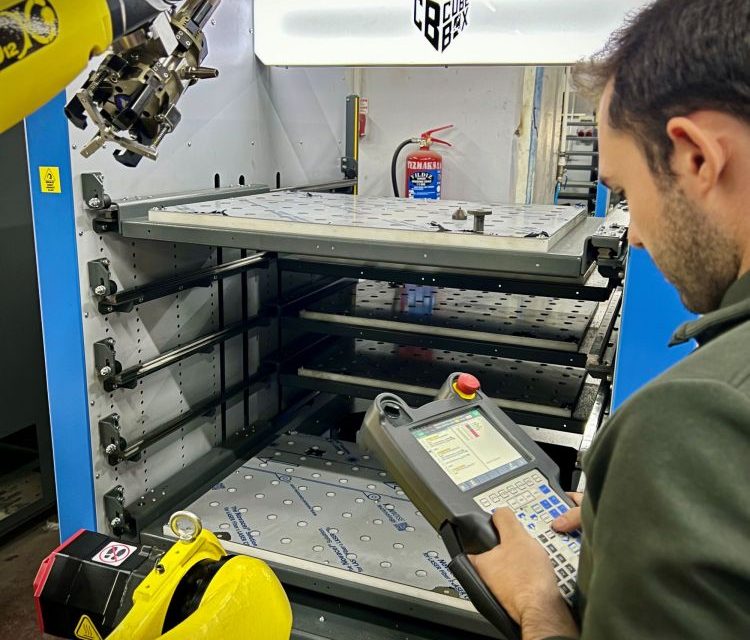
In CNC machine shops where recruitment is most challenging, flexible robotic cells can maintain operational continuity. A single team can supervise multiple machines, supported by robots that handle loading, unloading or secondary operations. With intuitive programming tools and simulation software, these systems are increasingly accessible to SMEs as well as larger manufacturers.
By working closely with customers, Tezmaksan develops solutions such as its CubeBOX system that reflect real operational needs. These automation cells allow human judgement and robotic consistency to operate side by side, extending capacity while preserving expertise.
Just as importantly, Tezmaksan places skills development at the centre of its approach. Through partnerships and training initiatives across Europe, the company supports the upskilling of CNC professionals so they are prepared to work confidently alongside advanced automation. These are not replacement roles but enhanced ones, offering clearer career paths and greater long-term value.
What Is the Future of CNC Manufacturing in Europe?
Europe’s CNC skills gap is real, but it is also an opportunity. By aligning automation with targeted training and a human-centred mindset, manufacturers can build resilient operations that are less vulnerable to labour shortages and more capable of sustained innovation.
The future of European manufacturing will not be defined by humans versus machines. It will be shaped by how effectively they work together. Companies that embrace automation as a tool for empowerment, redeployment and skills growth will be best positioned to protect productivity and maintain Europe’s legacy of precision engineering.
Contact Tezmaksan to explore how CNC automation can help unlock productivity, support workforce development and future-proof your operations.
Read other recent UK Manufacturing news: https://uk-manufacturing-online.co.uk/category/news/