The start of the third quarter saw further positive signs emanating out of the UK manufacturing sector. Upturns in production, new business and new export orders all gained momentum, while the impact of the twin headwinds of high cost inflation and severe supply chain disruption eased further.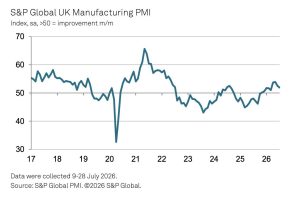
The seasonally adjusted S&P Global UK Manufacturing Purchasing Managers’ Index™ (PMI®) posted 51.9 in July, a four-month low and below June’s 52.5. The headline PMI has remained above the neutral 50.0 mark for nine consecutive months.
Four of the five PMI sub-components were at levels consistent with an improvement in overall operating conditions. Output, new orders and employment all rose, while average supplier delivery times lengthened. The month-on-month fall in the level of the PMI was due to a steep reduction in stocks of purchases, slower jobs growth and a sharp easing in the rate of increase in vendor lead times.
Manufacturing output rose for the fourth month running in July, with the rate of growth picking up to a near two-year high. Although all three product categories covered by the survey (consumer, intermediate and investment goods) registered expansions of output, imbalances between different company sizes were apparent. A mild downturn in production volumes at small-scale manufacturers contrasted with growth at medium and large sized firms.
The latest increase in production was strongly linked to rising intakes of new business from both domestic and export clients. Total new orders rose for the eighth successive month, with some firms noting an improvement in market conditions. New export business meanwhile rose for the seventh month in a row, amid reports of order growth from North America, the EU, mainland China, India and South Korea.
Business optimism remained relatively subdued despite the accelerations in output and new order growth, slipping to a three-month low. Manufacturers forecasting an expansion of output over the coming 12 months attributed this to stronger market conditions, new product launches and hopes for improved global economic and geopolitical conditions. Many nonetheless maintained concerns about the possible impacts of global trade tensions, tax rises and regulatory changes on future growth prospects.
Uncertainty about the future dragged on the labour market in July. Although staffing levels increased for the fourth successive month, the rate of growth eased to nearstagnation and was the weakest during the current upturn. While some manufacturers focussed on stepping up hiring to meet the needs of higher production and new orders, others reacted to concerns about the outlook by concentrating on cost-control and capacity-reduction initiatives. That said, there were some positive signs for the trend in staffing looking forward, as backlogs of work edged higher for the first time since April 2022.
July saw rates of increase in input costs and selling prices both cool further from recent peaks. Although the inflation signalled for both price measures remained above their respective survey averages, they eased to five- and fourmonth lows respectively. Manufacturers noted that a lessening of supply chain tensions and a drop off in demand for inputs had slowed the rate of increase in purchasing costs. A broad range of inputs were nonetheless reported as up in price, including chemicals, electrical and electronic products, food, metals and packaging.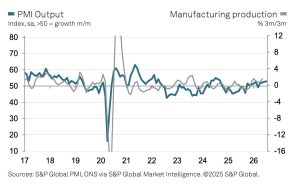
Although average vendor lead times lengthened for the thirtyfirst successive month in July, the rate of increase was the weakest since February. Purchasing activity decreased for the first time since March, while stocks of both inputs and finished products declined for the second successive month.
Rob Dobson, Director at S&P Global Market Intelligence, said: “July brought further encouragement for the UK manufacturing sector, as rates of growth in output, new orders and new export business all accelerated. The increase in production was the fastest in almost two years, as improving market conditions led to better hit rates in securing new contracts.
“There was also positive news on the price and supply fronts. The rate of increase in input costs slowed sharply to a five-month low as supply chain delays eased to their lowest since the outbreak of the war in the Middle East. Better resource availability and supplier reliability will hopefully provide further respite to squeezed supply chains in the months ahead, though developments in the Middle East will be key to supply and price developments in the coming weeks.
“These positive price and demand trends were not fully reflected in the labour market, with the upturn in manufacturing hirings grinding to a near halt in July, but the first rise in backlogs of work in over four years suggests employment could pick up in the coming months. This would be assisted if business optimism recovers from its current subdued level. Hopefully progress relating to geopolitics, global trade tensions and the direction of the new UK government’s industrial and tax policies will aid, and not hinder, this process.”
Read other recent UK Manufacturing news: https://uk-manufacturing-online.co.uk/category/news/