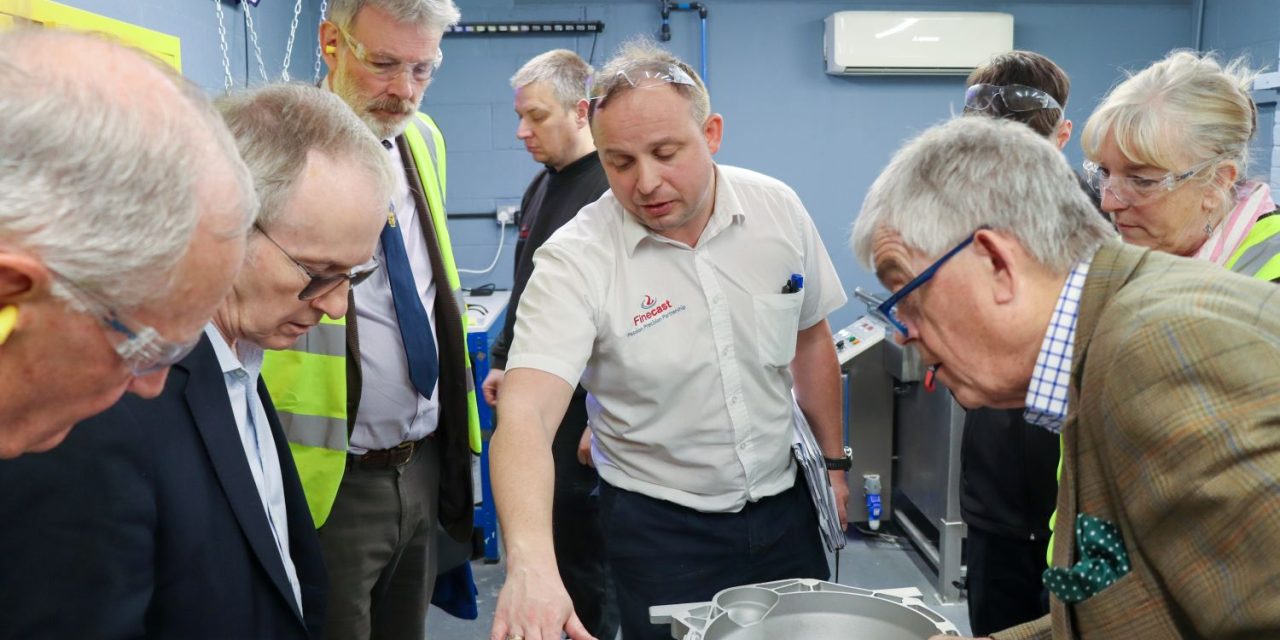
In March, Finecast, a West Sussex-based precision casting and machining specialist serving the defence, aerospace, automotive, motorsport, and energy sectors, opened its doors to a diverse delegation to address one of the most pressing challenges facing UK manufacturing today: the future of the domestic casting industry. 
Delegates comprised members of the Worshipful Company of Founders, a historic livery company dedicated to supporting and promoting the modern metals and casting industries. Also attending the event were industry leaders, academics, engineers and some of Finecast’s past and current apprentices.
The day began with an informal roundtable discussion, followed by a behind-the-scenes tour of Finecast’s advanced foundry and machine shop.
A sector under pressure
The UK casting industry has undergone significant contraction over recent decades. Once home to thousands of foundries, the UK now has only a few hundred remaining, with many closures occurring from the 1980s onwards as production shifted overseas to lower-cost economies in Eastern Europe and Asia. Industry bodies have repeatedly highlighted skills shortages, underinvestment, and global competition as ongoing pressures, with energy costs and policy uncertainty adding further strain in recent years.
Against this backdrop, the Worshipful Company of Founders continues to play an active role in supporting the sector through industry engagement, charitable initiatives and advocacy, including backing campaigns such as Back British Metals. Their visit to Finecast was part of a wider effort to understand how modern UK foundries are adapting to thrive.
Investing against the trend
Finecast’s story stands in contrast to the broader narrative of decline. Founded nearly 25 years ago when CEO Chris Heatley acquired a struggling foundry for £30,000, the business has grown into a trusted supplier to global manufacturers including Thales, Rheinmetall, Porsche AG, Jaguar Land Rover, and Safran.
“We always knew where we wanted to go,” said Chris Heatley, now in his 50th year in the industry. “The UK foundry sector has seen a huge amount of offshoring over the years, but what remains are highly specialised businesses operating at the top end. That’s where we positioned ourselves, from the very beginning.
“You can’t make something happen without investing, especially in people. We committed early on to developing skills, targeting the right markets, and building capability. That’s what’s allowed us to grow.”
That commitment continues today. Finecast has recently invested £2 million into its machine shop capabilities and is in the process of achieving NADCAP (National Aerospace and Defence Contractors Accreditation Programme) accreditation.
The company also employs advanced inspection technologies such as GOM (optical 3D metrology systems used for precise geometric measurement), reflecting its focus on quality and high-specification work.
Stuart Gunn, Quality Assurance Systems Manager, added: “Diversification is key to sustainability in casting. Entering sectors like aerospace requires significant investment — not just in equipment, but in processes, accreditations and people. It’s a challenge, but it’s essential if UK foundries are to compete globally.”
A new generation of foundry talent
One of the most striking aspects of Finecast’s operation is its workforce. With an average employee age of just 30 and a management team largely aged between 25 and 38, the company has one of the youngest skilled teams in the British Isles.
This is no accident. Finecast offers apprenticeships from age 16 and has built its leadership pipeline internally, with many senior staff having progressed through Level 3 and higher apprenticeships.
David Gratton, Managing Director, said: “Attracting young people into manufacturing is absolutely critical. The industry has historically struggled to promote itself, but the reality is that modern foundries are highly technical, innovative environments. We’re working hard to change perceptions and create real career pathways.”
Among those pathways is Brooke Chilton, 18, who joined Finecast after initially training as a mechanic. Now undertaking a Level 3 engineering apprenticeship, she said: “I wanted a new intellectual challenge. I enjoy CAD and engineering, and the foundry gives me the chance to apply that in a real-world environment. It’s a male-dominated industry, but I’ve felt supported, and I’d love to move into the machine shop in the future.”
Archie O’Leary, 20, joined straight from school and has rotated across multiple departments before finding his niche in quality assurance. “There are so few foundries left in England,” he said. “Here, you get exposure to so many skills. I definitely see a future for the industry.”
Industry voices: cautious optimism
Visitors to the event echoed both the challenges and opportunities facing the sector.
Pam Murrell, Chair of the Industry Committee of the Worshipful Company of Founderss, emphasised the strategic importance of the foundry industry to UK manufacturing: “This industry is vital for the economy, providing good jobs and precision engineered parts for a wide range of sectors that support our sovereign capability and environmental sustainability. Casting plays a key role in the circular economy through metal recycling, and we can do more to promote careers in the foundry industry to young people. It’s a sector rooted in making things that matter.”
Tom Westley, Chairman of the Westley Group, a seventh-generation foundry business, added: “The future is bright where the UK can deliver world-class, specialised products. It’s about focusing on complex, low-volume, high-value work, and staying agile.”
Felix Martin of the University of Warwick highlighted the need for industrial engagement: “There’s a real opportunity for foundries operating as very high value manufacturers. We also need to ensure young people have access to hands-on, practical careers, in addition to traditional academic routes.”
Navigating uncertainty and the road ahead
The roundtable also addressed broader economic and political challenges, including the impact of Brexit. Finecast’s leadership noted that changes to trading relationships required a strategic reset.
“Brexit forced us to diversify,” said Chris Heatley. “We couldn’t rely on previous markets, so we had to adapt, bringing in specialists, investing during uncertain times, and staying focused on long-term goals. It wasn’t easy, but it made us stronger.”
The visit comes shortly after Finecast was selected by the UK Ministry of Defence for the Defence Supplier Capability Development Programme (DSCDP), placing it among just 10 SMEs chosen from 561 applicants nationwide.
The programme recognises high-potential suppliers critical to strengthening the UK’s defence industrial base.
“It’s a challenging time to be a UK manufacturer,” Heatley concluded. “But it’s also an interesting one. There is opportunity if you’re prepared to invest, adapt, and believe in what you’re building.”
Read other recent UK Manufacturing news: https://uk-manufacturing-online.co.uk/category/news/