“There’s nothing efficient about innovation,” once said the British-American author and inspirational speaker, Simon Sinek. But is he correct? The onus is on manufacturers to innovate and keep up with the changes, particularly those driven by e-mobility. Here, Robert Smith, Offer Manager for Hole Making & Composites within the Solid Round Tools (SRT) Business Unit of cutting tool specialist Sandvik Coromant, explains how manufacturers can — and must — innovate with efficiency with advanced solid carbide drills.
Design for manufacturability (DFM) has become increasingly important for manufacturers in a range of sectors — including automotive, aerospace and general engineering. DFM means designing and developing products that can be manufactured more easily, efficiently and cost-effectively. For Sandvik Coromant’s customers, this normally translates to achieving a favorable cost-per-part when machining components; or cost-per-hole in drilling and tapping applications. Each of these objectives require cutting tools that are very reliable and support high productivity.
What’s more, the concept of DFM is evolving due to an increasingly-globalized supply chain and growing demand for customized products. E-mobility will affect DFM too. Parts for electric and hybrid vehicles are more varied, from manufacturer to manufacturer, than their internal combustion engine (ICE) equivalents and are made increasingly from tough materials like low-alloy steels, Inconel and aluminum. While e-mobility trends in aerospace are still years away, the trends in automotive are upon us right now — manufacturers must keep up with the changes, or risk getting left behind.
But how can advanced tooling solutions make a difference to DFM? Answers can be found at the computer aided design (CAD)-to-component phases of manufacturing. CAD-to-component can refer to three stages of manufacturing. First, the CAD-to-spindle phase in which CAD and computer aided manufacturing (CAM) models, including digital twin-like simulations, are used to prepare a machining operation and ensure the tooling, workpiece and machining parameters are all optimized.
Second, the spindle stage, or the actual machining operations. Here, we can assess the machining performance of the tool against the workpiece, and its effect on cost-per-part, cost-per-hole and — ultimately — our customers’ bottom line. Third, there is the simple-to-component phase where the quality and finish of the final component are assessed. Whether for automotive, aerospace or general engineering, finish and features like hole surface integrity are of paramount importance. Better hole quality prevents component failure — and depends very much on the manufacturing processes that are used for machining or finishing the holes.
In particular, a drill’s design is integral to producing better quality holes. This is why cutting edge-geometries in drills are continually evolving, as it is important to meet the highest standards of manufacturing and part quality. Use of coolant is also important to reduce heat build-up in the tool. This is where Sandvik Coromant’s specialists can play a crucial role in supporting its customers.
Manufactured easily
Sandvik Coromant works side-by-side with the customer to gather all the relevant information on their machining project and see what’s required. Let’s say the customer needs to perform a continual drilling operation in a 316L stainless steel workpiece — a material that, as shown in a study published by the Asian Research Publishing Network (ARPN) Journal of Engineering and Applied Sciences, has been found to call “fast and fatal wear” that severely impacts the life of cutting tools.
At this stage of the customer’s machine process, the aforementioned CAD-to-spindle stage, our specialists can examine and reverse engineer the customer’s processes including the use of CAD and CAM models. In doing so, Sandvik Coromant is able to develop a tool prototype in the morning and have it ready for testing within R&D in the afternoon. In the days before digital, this process would have required that drawings be posted back-and-forth and would have taken up-to-six weeks. Today, having the capability to deliver tool prototypes same-day has been a game-changer for Sandvik Coromant.
Increased tool life
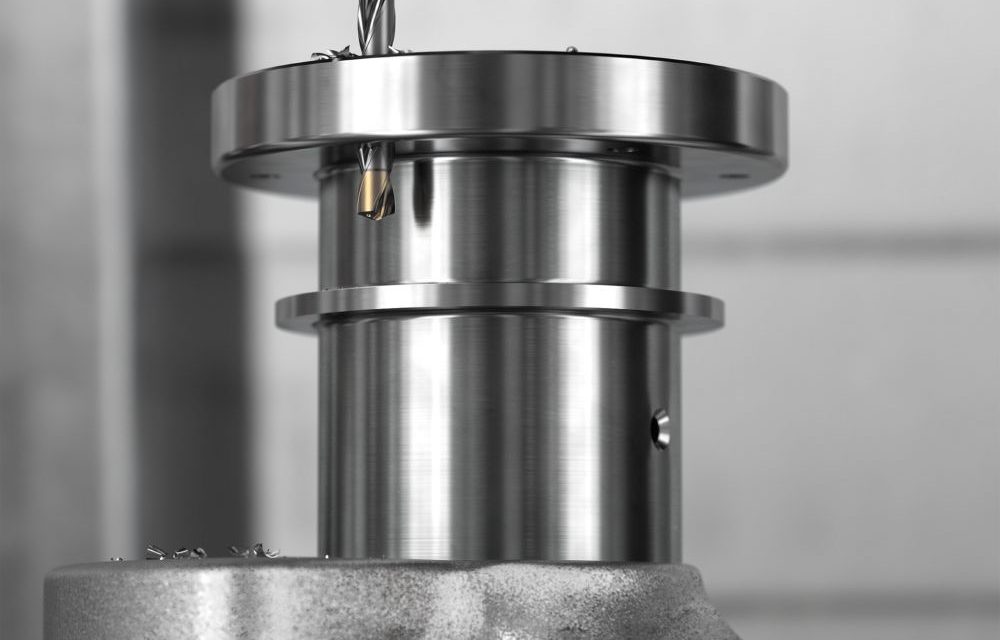
Sandvik Coromant offers a range of products to support its customers in manufacturing components, including for e-mobility. They include CoroDrill® 860, a solid carbide drill designed for fast and problem-free drilling, maximizing productivity through high metal cutting efficiency. The tool is available in a range of geometries, including 860-MM for long-chipping stainless steel materials such as austenitic, super austenitic, ferritic and duplex stainless steels.
And there is CoroDrill® 860-GM that, for automotive manufacturers, has proven useful for drilling engine blocks, casings, flanges and manifolds. The drill is also suitable for all applications beyond automotive and general engineering, where hole quality is critical — such as in aerospace, oil and gas, nuclear and renewable power.
The 860-GM has achieved impressive results, including for an automotive manufacturer in Korea. The Sandvik Coromant customer’s operation was to drill through holes in a production batch of automotive transmission connectors. The goal was to drill eight 8.2 mm (0.32”) diameter through holes into each component, measuring a depth of 10 mm (0.39”). The existing solution produced 200 components, 1600 holes in total, with a cutting speed (Vc) of 80m/min (3102 RPM) and cutting feed (Vf) of 381 mm/min. In comparison, the CoroDrill® 860-GM produced 2300 components (18400 holes) with a Vc of 100m/min (3878 RPM) and Vf of 814 mm/min.
Overall, CoroDrill® 860-GM delivered a significantly-improved tool life of 1150%. This was accompanied by a productivity increase that helped significantly lower cost-per-part for the customer. Similarly-impressive results have been reported by other Sandvik Coromant customers in automotive, around the world.
Just as important as drilling smooth holes is tapping, the action that creates a thread inside of the hole. For this, Sandvik Coromant offers the CoroTap® 100, 200, 300 and 400, each optimized for different applications. To look at a couple of examples, CoroTap® 100 is a range of straight flute taps that are optimized for short chipping ISO K, ISO N and ISO H materials. Meanwhile, CoroTap® 400 is a high-speed, chip-free forming tap suitable for both through- and blind-holes in steel, stainless steel and aluminium. The customer’s choice depends on what is best for their application.
Going forward, Sandvik Coromant will offer CoroTap® 100-N and CoroTap® 400-N. Each is designed to support customers with tapping applications in aluminium, which is becoming more prominent in manufacturing processes.
For now, the performance of Sandvik Coromant’s cutting tools shows how tools designed to support the drilling and threading of multiple materials will be vital in helping manufacturers produce lighter, smaller and more varied components. Not only can machine shops design and develop these parts more easily and cost-effectively, they can ensure that DFM remains a priority throughout their manufacturing ― and innovate with efficiency.
To find out more about solid carbide drills for fast and problem-free drilling, visit Sandvik Coromant’s website.