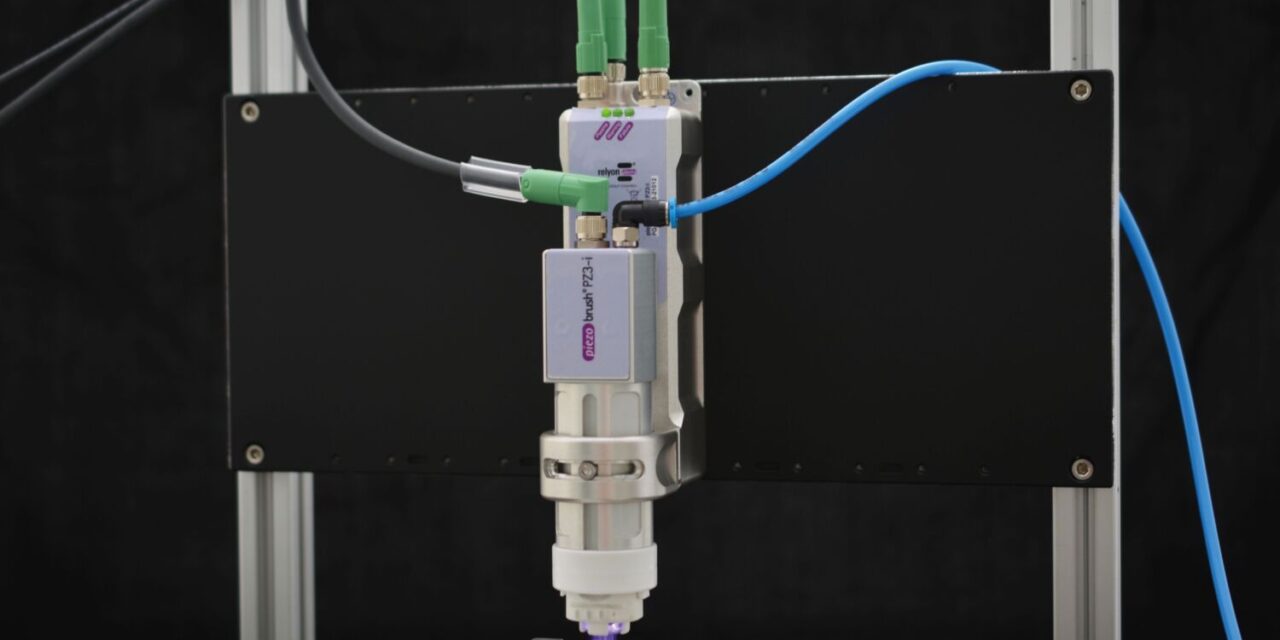
The use of the piezobrush PZ3-i Plasma Surface Treatment device, available in the UK from Intertronics, has enabled effective continuous inkjet printing onto PTFE fabric. Combined with a KEYENCE MK-G1000SA continuous inkjet printer, the customer could print readable markings with good resistance to temperature and friction.
Due to PTFE’s extremely low surface energy and chemical inertness, it is difficult for materials to wet, and almost no materials or adhesives adhere to it without some form of surface pre-treatment. One simple option is the application of plasma, which will alter chemical groups on the surface, increase wettability and creating bonding anchors for the material. The Relyon Plasma PZ3-i is compact generator of cold plasma that can be readily installed into any process.
Recently, a tool solutions company was looking for way to reliably print a Data Matrix Code (DMC) onto PTFE fabric. It turned to the new piezobrush® PZ3-i, in combination with a KEYENCE MK-G1000SA continuous inkjet printer. The customer tested five different fabrics; once they had been pre-treated with the PZ3-i, the DMC was printed in KEYENCE MK-13 test ink. For all materials tested, the surface energy was less than 30 mN/m without pre-treatment and between 38 – 42 mN/m after plasma treatment.
Plasma pre-treatment was found to be absolutely essential to reliably mark the fabric, as below a surface energy of 38 mN/m the printed image appeared faded, was not abrasion resistant, and the DMC could not be read. With plasma pre-treatment, the readability of the DMC was good, while resistance to temperature and friction was satisfactory.
“This is a great example of where surface pre-treatment enables a bond where it would otherwise not be possible,” said Ben Swanson, Chief Commercial officer at Intertronics. “The small-scale nature of the PZ3-i meant the customer could achieve a processing performance level that would otherwise only be possible using larger and more expensive equipment, or the use of hazardous chemicals.”
The PZ3-i is designed specifically for integration into fully or partially automated systems, and allows you to combine the effectiveness of plasma surface activation for improved adhesion, wetting, and cleanliness of substrates, with the superior productivity and repeatability of automation. It only requires 24V DC power and dry compressed air, and doesn’t need complex safety enclosures or PPE. The device is intuitive to operate and can be maintained without tools. It is compact, lightweight, modular, safe and efficient, and can be quickly and easily integrated into production lines.