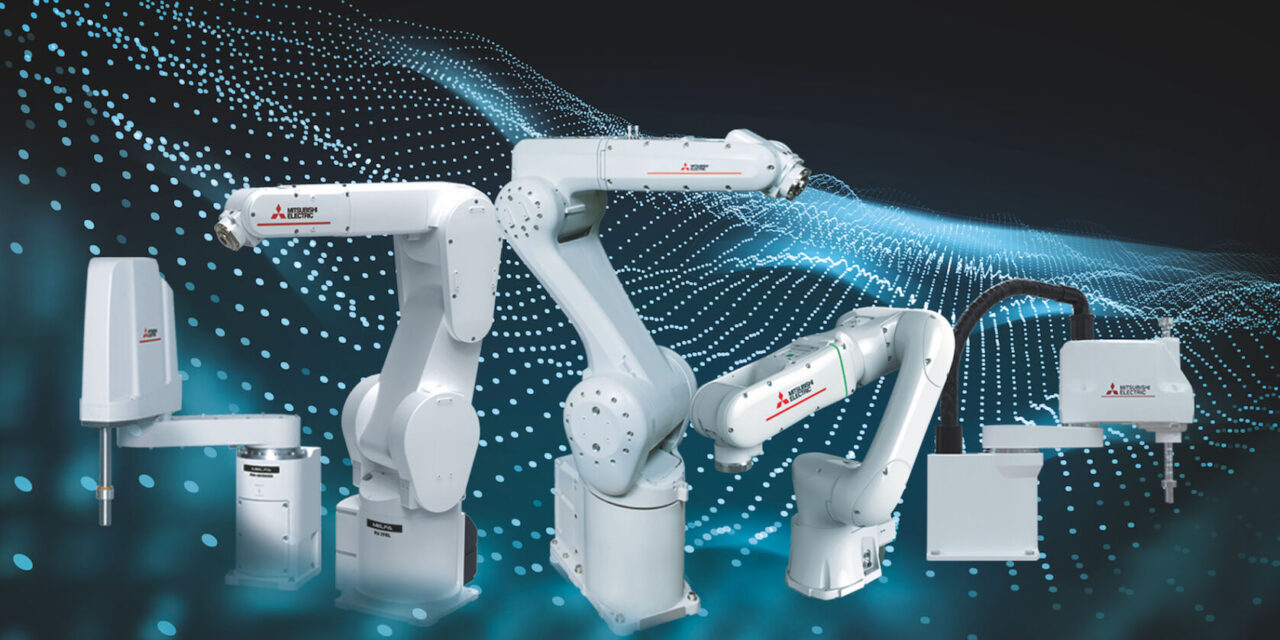
Robots are continuing to advance significantly, creating a diverse ecosystem of solutions, which support an increasing variety of industries and applications. As a result, future-oriented factories are able to select robotic systems that meet the requirements and goals of virtually any activity. Thanks to its comprehensive range of robots, Mitsubishi Electric can help companies build smart and customised automation solutions that improve shop floor operations.

Industrial robots offer flexibility, high accuracy and fast movements.
[Source: Mitsubishi Electric Europe B.V.]
Increasing productivity whilst keeping employees safe
It is getting harder and harder to attract people into the manufacturing industry, therefore the employees available need to be able to operate as effectively as possible. Having them perform repetitive tasks does nothing for the employee nor the employer. For the employee, these are not interesting, motivating or well-paid activities. For the employer, positions involving such tasks are hard to fill, there is a risk of injury through repetitive strain injuries (RSIs) and involve inefficiencies. Automation can free up human labour, enabling staff to get involved in more enticing activities.
Furthermore, whilst labour costs have and will continue to rise, the cost of automation remains constant, or even decreasing. There has never been a more cost-effective opportunity to move to automated solutions. Also, thanks to automation, production can continue whilst the factory is unmanned, for example at night. This could help businesses manufacture high-volume products at night, whilst small batch items can be made during the day, as they require manual interventions.
Industrial robots can be at the centre of this move towards automation. They are easy to install, can be easily integrated, offer flexibility, high accuracy and fast movements. Their fast cycle times can even increase productivity. Even more, robots can operate in many different environments, such as automotive, electronics, pharmaceutical and food and beverage facilities.
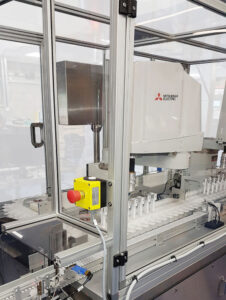
Robots can operate in many different environments, such as automotive, electronics, pharmaceutical and food and beverage facilities.
[Source: Mitsubishi Electric Europe B.V.]
A robotic solution for constrained workspaces
This means that automated machines do not necessarily require large work envelopes, as many tasks involving lightweight items, which also take up less space. There are many processes where compact, cost-effective set-ups are not only beneficial but actually a must. For example, where space is limited, technologies with a smaller footprint can be deployed to improve low to medium complexity applications.
To address these requirements, companies can select space-saving products such as those in Mitsubishi Electric’s RH-CH series of small and highly economical SCARA robots. These, as well as the RV series of six-axis industrial robots, can be equipped with the MELFA SafePlus safety system to make the most of compact workspaces by leveraging cooperative functionalities. In practice, the robots can operate at high speed when their workspace is clear, but slow down or stop completely if movement is detected in their vicinity. This is achieved using safety sensors, combined with a built-in safety monitoring function in the robot’s controller. As a result, industrial robots in cooperative mode can be utilised in an open environment, without requiring a physical safety barrier.
Integrating robots into a process has never been easier than with MELSEC iQ-R and iQ-F series PLCs. Connected to these PLCs, GOT 2000 HMIs and to the Cloud, highly interconnected robots can help to create connected factories for next-level performance and smart operations. Finally, they can be linked to software platforms that support real-time troubleshooting, maintenance and diagnostics, such as the GENESIS64 visualisation tool from ICONICS.
Hand in (robotic) hand
When companies need to accommodate limited space and frequent interactions between operators and robots, collaborative robots (cobots) are the answer. These incorporate advanced safety features that can include a special design to prevent pinch points, limited torque and speed as well as the possibility to stop the robot by hand.
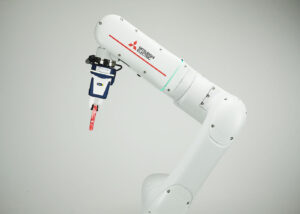
Cobots are ideal for applications with limited room and frequent interactions between operators and robots.
[Source: Mitsubishi Electric Europe B.V.]
Besides, the MELFA Assista offers an additional hand-guided teaching function. Users can manually move the cobot into a position, which is then added to the work sequence by pressing a button on the robotic arm.
Finally, external devices, such as vision systems, can be connected to the collaborative solutions to develop cutting-edge applications.
Automation on the move
With such a comprehensive portfolio of robotic systems, Mitsubishi Electric can provide the right solution for a wide range of applications. Backed by extensive experience and technical knowledge, the company’s specialists can provide guidance on which robot is best for any customer project. As a result, machine builders and users can enhance their operations and, ultimately, their competitiveness in a fast-paced marketplace.